Best 5 Stud Finders in the UK (2026)
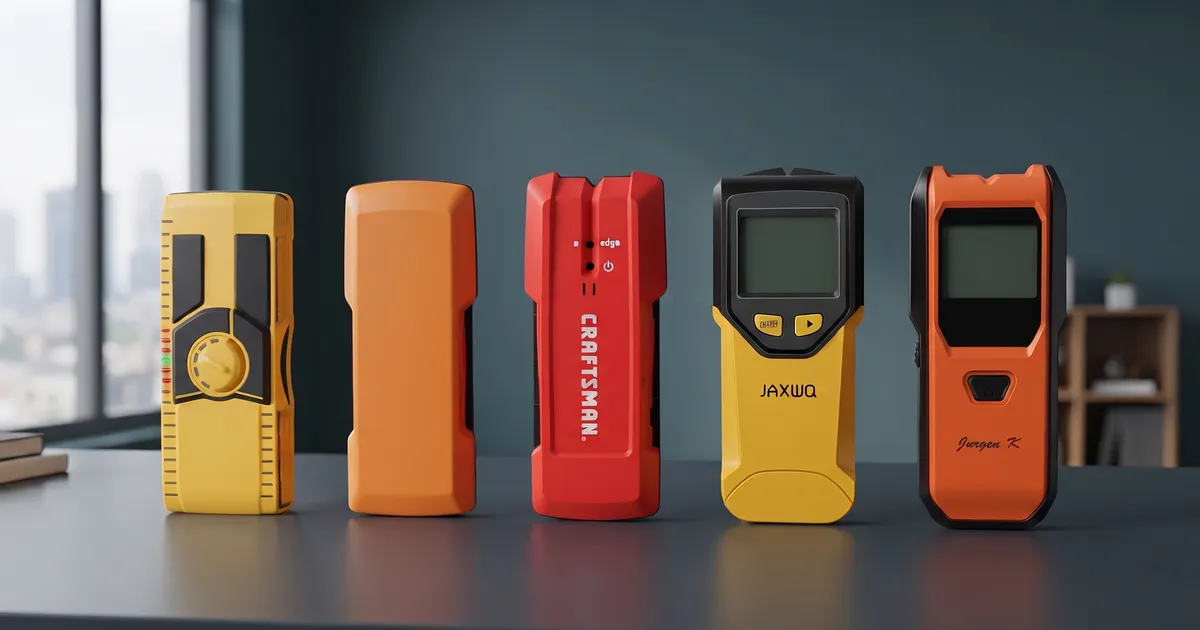
“Unfortunately, the accuracy was pretty much hit or miss. Sometimes it would detect a stud where there clearly wasn't one, and other times it would completely miss a stud that I confirmed being there using traditional methods. This led to a ton of second guessing, more holes, and a good amount of frustration.”
— Ronny Ondi · Buyer
Hanging a heavy mirror, mounting a television, or securing shelving requires knowing exactly where framing sits behind drywall. Missing a stud means drilling useless holes, damaging wall surfaces, and risking fixtures pulling away from the wall under load.
Finding that solid wood or metal framing often proves frustrating. Electronic scanners frequently show varying edges, fail to repeat readings across multiple passes, or require constant recalibration. Meanwhile, magnetic tools only latch onto hidden drywall fasteners, leaving the rest of the stud's path up to guesswork. Choosing the right tool comes down to whether you prefer multi-sensor electronics that show whole stud widths or simple magnetic tools that never need batteries.
So we read what the buyers quoted here report and set these 5 side by side. Every quote comes from a real review we keep on file. Our top pick comes first; if it is not your fit, the others are there for different needs.
How this list was built
By the numbers
- Buyers
- 26
- Listings
- 5
- Reviews quoted
- 41
- Picks
- 5
How the shortlist was drawn
- Retail Availability
- Detection Method
What each pick was judged on
- Accuracy and Consistency
- Calibration Simplicity
- Hazard Warnings
Read the full method
The editor selected these products based on their retail listings, and the findings presented here come directly from buyer reviews quoted verbatim. What is described alongside those excerpts is drawn from recorded specifications, owner accounts, and standard characteristics of wall scanners.
How the shortlist was drawn
- Retail AvailabilityChosen by how much buyers bought, reviewed, and rated it, one per brand, listed new and in stock on Amazon UK when this guide was built.
- Detection MethodModels offering either electronic density scanning across drywall or high-strength magnetic detection of wall fasteners.
What each pick was judged on
- Accuracy and ConsistencyHow reliably the device identifies framing centers and edges without producing random false signals.
- Calibration SimplicityThe ease of starting a scan without complex setup steps or sensitive pressure requirements.
- Hazard WarningsThe ability to alert users to live AC electrical wiring hidden behind the wall.
- Prices are not listed. They move constantly and a stale number helps nobody — the retailer shows what it costs right now.
- No brand or retailer pays TrueValuePick for a place on this list: no ads, no paid placement. How a guide is put together
Our top 5 picks


Pick 1 of 5
Best overall
- Most recommended
- Easiest to live with

Franklin Sensors Stud Finder
A 13-sensor electronic scanner shows the entire stud width and centers simultaneously without requiring manual wall calibration.
Price and availability are shown on Amazon.
Best for
- Wide framing identification: multi-LED display reveals single and double stud widths clearly
- Quick scanning: starts instantly anywhere on the wall without baseline calibration
Skip it if
- You want a pocket tool with no batteries: #2 runs purely on permanent magnets
Our verdict
The Franklin Sensors ProSensor M210 stands out from conventional scanners by utilizing an array of 13 sensors. Instead of requiring users to slide past both edges to find a center point, it illuminates multiple LEDs across its face to show the full profile of single or double studs in real time.
Owners report that scanning is fast and straightforward because it does not require a blank-wall calibration step before pressing the button. Moving the unit back and forth quickly confirms solid timber framing versus fleeting surface errors, and the integrated bubble level aids straight mounting marks.
The catch is that the housing is bulkier than single-sensor alternatives, and minor flicker can happen if swept too quickly across textured surfaces.
Pros & cons
Pros
- Instant scanning: requires no blank-wall calibration step
- Full width display: illuminates multiple lights to show the entire stud and double studs
- Built-in level: includes an integrated bubble level for marking
- Live wire sensing: alerts to active wiring behind walls
Cons
- Can flicker: requires sliding back and forth to verify occasional false lights
- Larger footprint: wider than basic single-sensor pocket finders
What owners say
The Franklin Stud Finder is well made easy to use and works well. The Finder is very sensitive to changes in the wall and the lights that are used to determine where your stud or studs are in the wall works well and is precise.
William Graboritz Jr · Buyer
This stud finder provides great detection of studs and live wires with great accuracy! The sensors in this finder get the job done with no missed studs and giving me higher confidence in avoiding wires inside the wall. The built in level is also another nice feature.
Lou G · Buyer
this is the easiest to use, most accurate stud finder I’ve ever owned.
Gregory Gianakis · Buyer
Works great , finds the edges nightly .
Steemer · Buyer
It sometimes shows some misinformation but if you move it back and forth you will quickly know what is actually there and what is just an error. It nicely shows you where the stud is by lighting up multiple lights that are above the stud. As you move it you can see that if they stay in the same spot and don't flicker on and off you know there's a stud there including wider patterns for double studs.
Justin · Buyer
Our conclusion
Choose this model if you want an easy multi-light display that indicates whole stud widths and centers without calibration steps. If you prefer a completely battery-free tool that snaps directly to drywall screws, #2 is a simpler option.
Pick 2 of 5
Best battery-free magnetic
- Least upkeep
- Built to last

The StudBuddy Stud Finder 001
A compact magnetic block snaps firmly onto hidden drywall fasteners without ever needing batteries or surface calibration.
Price and availability are shown on Amazon.
Best for
- Zero-maintenance setups: contains no circuits, screens, or batteries
- Hands-free marking: hangs in place on drywall screw heads once snapped on
Skip it if
- You need to verify continuous framing or pipe vs timber: #1 scans deep wall density
Our verdict
The StudBuddy relies on high-strength neodymium magnets housed in a durable plastic casing. Sweeping it across drywall in an S-pattern causes it to snap directly onto buried metal screw or nail heads holding the drywall to the studs.
Buyers note that because it holds firmly against fastener heads, it leaves hands free to hold a level or mark drill points with a pencil. It completely bypasses the battery drain, sensor drift, and false alarms common to electronic wall scanners.
The trade-off is that it only finds individual fastener points. If a fastener is missing along a section, or if a screw was driven off-center, you must locate multiple screws vertically to estimate the stud line.
Pros & cons
Pros
- No power needed: operates without batteries or electronics
- Hands-free hold: stays attached to the wall over metal screws
- No false electronics: eliminates calibration errors and sensor drift
- Compact size: weighs just 1.6 ounces and fits easily into tool pockets
Cons
- Fastener dependent: cannot detect framing where screws are absent
- No material discrimination: does not differentiate between stud screws, metal pipes, or junction boxes
What owners say
Studbuddy found 1-2 nails of two different studs but I could not locate the whole stud or the direction of the stud, especially, where it was off by an inch or two from top to bottom.
Himms · Buyer
You simply sweep this little plastic block in an S-pattern across the drywall until the rare earth magnets violently snap onto a drywall screw, identifying the exact center of the stud every single time.
John Degen · Buyer
Simple concept - strong magnet sticks to the drywall screws...very well in fact. It only took me about 5 seconds to find a stud vs others I tried that were hit and miss.
Matt · Buyer
I was able to locate studs in drywall within seconds, and the strong magnets held securely once they found a fastener, giving me confidence before drilling or mounting shelves, TVs, and picture frames. There's no need to worry about calibration or false readings like some electronic stud finders.
Minh Diesel · Buyer
Our conclusion
Get it if you want an unbreakable tool that finds drywall screws within seconds without batteries. If you need to detect wood width, live wires, or non-ferrous wall changes, #1 provides full electronic scanning.
Pick 3 of 5
Best compact edge scanner
- Great for beginners

CRAFTSMAN Stud Finder CMHT77633
A streamlined edge detector identifies wood and metal framing boundaries through standard 3/4-inch drywall.
Price and availability are shown on Amazon.
Best for
- Small toolboxes: compact profile stores easily in pockets or pouches
- Simple edge marking: alerts directly when reaching stud boundaries
Skip it if
- You want continuous full-width visual confirmation: #1 displays the entire stud profile
Our verdict
This Craftsman scanner focuses on basic edge detection within a 3/4-inch depth range. It uses a single 9-volt battery to power a compact, shock-resistant housing designed for straightforward wall checks.
Owners appreciate the minimalist controls and durable feel, noting it fits into tight toolbox compartments and quickly identifies framing borders when hanging wall decor.
However, users report that accuracy can be inconsistent on certain walls, occasionally skipping known studs or signaling false edges if not moved at a steady rate.
Pros & cons
Pros
- Compact build: small footprint stores easily in any toolbox
- Simple controls: operates with straightforward edge alert signals
- Durable body: built with a shock-resistant plastic housing
- Standard battery: runs on an easily sourced 9V battery
Cons
- Hit-or-miss accuracy: can produce occasional false readings or miss studs
- Edge-only scanning: requires scanning from both sides to find stud center
What owners say
Instead of guessing where the studs were and hoping for the best, I was able to quickly locate them before drilling.The tool is straightforward to use and doesn't require a lot of setup.
PurpleBear · Buyer
Unfortunately, the accuracy was pretty much hit or miss. Sometimes it would detect a stud where there clearly wasn't one, and other times it would completely miss a stud that I confirmed being there using traditional methods. This led to a ton of second guessing, more holes, and a good amount of frustration.
Ronny Ondi · Buyer
This is small, easy to use and just about anyone who has ever hung anything on a wall, would love to have !
CAT I AM · Buyer
Our conclusion
Choose this model if you need a sturdy, compact edge scanner from a traditional tool brand. If you struggle with inconsistent readings, #1 offers multi-sensor verification.
Pick 4 of 5
Best backlit digital display

JAXWQ Stud Finder TH410
A multi-mode wall detector combines an illuminated LCD screen with audio beeps for stud, metal, and AC wire identification.
Price and availability are shown on Amazon.
Best for
- Low-light spaces: bright backlit display shows scan status clearly
- Multi-material detection: separate modes for wood, deeper objects, metal, and AC lines
Skip it if
- You dislike delicate calibration steps: #1 requires no wall calibration before scanning
Our verdict
The JAXWQ TH410 features a prominent backlit LCD screen that displays target center indicators, signal bars, and battery levels alongside an audible alert tone. It offers dedicated modes for wood studs, deep scans, metal pipes, and live AC wiring.
Owners note that the clear display and wire warnings provide good feedback when prepping to mount shelving or heavy wall fixtures once the device is properly calibrated against the wall.
The main drawback is sensitivity to user technique. Lifting the device off the wall or altering hand pressure during a pass will invalidate the calibration and cause inconsistent readings.
Pros & cons
Pros
- Clear screen: backlit LCD is easy to read in dimly lit areas
- Audio feedback: beep signals confirm target approach and centers
- Multi-mode scanning: includes stud, metal, deep, and live AC wire settings
- Lightweight build: easy to maneuver across walls and ceilings
Cons
- Strict calibration: lifting the scanner requires restarting the calibration process
- Pressure sensitive: uneven hand pressure across the wall causes false readings
What owners say
Setup was simple, and the calibration process only takes a few seconds before scanning. It quickly detects studs, metal, and live wires, which gave me confidence when mounting shelves and hanging heavier items.
Sabrina D D'Angelo · Buyer
You can scan the same area several times at the same speed and in the same direction, and the unit will randomly signal a stud or not in the exact same position.
Julie M · Buyer
you have to CALIBRATE the unit each time you are looking for a wood stud. Turn it on, set to stud, place on the wall and press the calibrate button, when it beeps start moving on wall to locate the stud. DO NOT LIFT FROM WALL OR YOU HAVE TO START OVER. Once I got that right no more issues.
NLM4501 · Buyer
The issue is that you have to keep the amount of pressure against the wall very precisely the same as you move it, or it'll give you a false reading. I also sometimes had to move it up and down where I knew a stud was before it would actually start detecting it. It also almost never detects the center of the stud properly, so you're still going to have to figure that out yourself.
Sybil W. · Buyer
Our conclusion
Opt for this scanner if you want visual screen feedback and multi-mode scanning for metal and wiring. If you want to avoid recalibrating between passes, #1 provides a more forgiving workflow.
Pick 5 of 5
Best continuous scan operation

Jurgen K Stud Finder TH530
A 5-in-1 multi-scanner features a stay-on power switch that eliminates holding down a scan button while working on ladders.
Price and availability are shown on Amazon.
Best for
- Ladder work: power switch stays active without maintaining thumb pressure
- AC wire tracing: dedicated electrical scan mode tracks live wiring paths
Skip it if
- You frequently scan through plywood siding: owners report false readings on exterior sheathing
Our verdict
The Jurgen K TH530 provides five distinct scanning depths and material settings on a bright green LCD screen. A notable ergonomic benefit is that scanning remains active without needing to hold a trigger button continuously, making ladder work and awkward hand repositioning easier.
Buyers report that the live AC detection effectively traces the paths of active electrical wires, and the included 9V battery allows immediate setup out of the package.
On the downside, edge measurements can vary by a couple of centimeters across repeated passes, and nearby plugged-in appliances can trigger broad AC alerts across large wall sections.
Pros & cons
Pros
- Hands-friendly toggle: scanner stays on without holding a button down
- Battery included: comes supplied with a 9V battery
- Bright green LCD: screen is sharp and fast to register density changes
- AC wire pathing: tracks the direction of live electrical lines
Cons
- Varying edge readings: scan margins can fluctuate slightly across passes
- Electrical sensitivity: plugged-in devices nearby can make large wall areas register as active
- Plywood struggles: gives false readings through thick plywood siding
What owners say
However, and this may be due to user ignorance, it seems that whenever I use it around electrical devices that plug in to the wall I'm trying to find the studs in, it shows that the entire wall is electrically active.
B.G. · Buyer
The product had clear instructions and was easy to use, however, the readings varied with each scan. I would pass over one wood stud using the same setting at the same wall height and would get a few different readings. The edge readings ranged about 2 cm, but the centers were somewhat more accurate (about 1 cm range).
yeseul · Buyer
Instructions that came with it are easy to understand. Even came with a 9V battery which is a plus. Like other users have mentioned you have to move this slowly across the wall to get an accurate measurement. The AC finder actually works well, and "shows" where the path of the wire goes. Deep scan works well too.
willi · Buyer
I ran it over a wall multiple times, no indication of a stud, drilled and ran into a stud.
Mike B. · Buyer
Our conclusion
Get it if you want continuous scanning without holding down a button while reaching high walls. If you want pinpoint multi-sensor accuracy on framing width, #1 is the better fit.

Buying guide
Sensor Arrays vs. Single Sensors
Basic electronic wall scanners use one or two sensors, requiring you to slide the tool back and forth to mark two edges and calculate the center point. Multi-sensor models, such as #1, use an array of detection points to illuminate the entire width of the framing at once, including double studs, without needing edge-to-edge calculation.
Magnetic Detection vs. Electronic Scanning
Magnetic finders like #2 contain no electronics, circuits, or batteries. Instead, strong magnets snap onto metal drywall screws or nails driven into the framing. While they never produce electronic false positives or require calibration, they only find individual fasteners rather than the continuous timber beam.
Handling Calibration and Live Wires
Most single-sensor electronic models require holding the tool flat against a clear section of wall before pressing a calibrate button. Lifting the device or changing wall pressure midway often causes false readings. Models with AC scanning can detect live electrical lines, though surrounding plugged-in electronics can occasionally make wide areas appear active.
Mistakes buyers keep making
Drawn from what buyers complain about in their reviews.
Uneven Scanning Pressure
Pressing too hard or varying your hand pressure across drywall causes single-sensor digital finders to register false edges.
Lifting Mid-Scan
Electronic scanners that require manual calibration will throw errors if lifted away from the surface before the pass finishes.
Assuming Fasteners Match Plumb
Magnetic finders locate isolated drywall screws, but framing underneath can occasionally bow or run slightly off plumb between screw locations.
Ignoring Live Wire Interference
Active electrical outlets and plugged-in cords nearby can cause AC detection modes to flag large wall sections as electrically live.
Frequently asked questions
How were these 5 stud finders chosen?
Chosen by how much buyers bought, reviewed and rated it, one per brand. Every pick was listed new and in stock on Amazon UK, with a price, when this guide was built.
Can magnetic stud finders detect the actual wood stud?
No, magnetic finders only detect ferrous metal drywall screws or nails that secure the drywall sheet to the framing.
Why does my electronic stud finder beep across the entire wall?
Electronic scanners can give false readings if calibrated over a stud, if hand pressure changes during a slide, or if electrical noise interferes with live wire sensing.

Gary Lindgren
Editor, Tools & DIY guides
Gary Lindgren covers tools and DIY gear for TrueValuePick, building each guide from what owners report in public about the drills, saws and workshop tools they use.
Compiled this guide from buyer reviews, each one checked against an archived copy of the listing it came from.